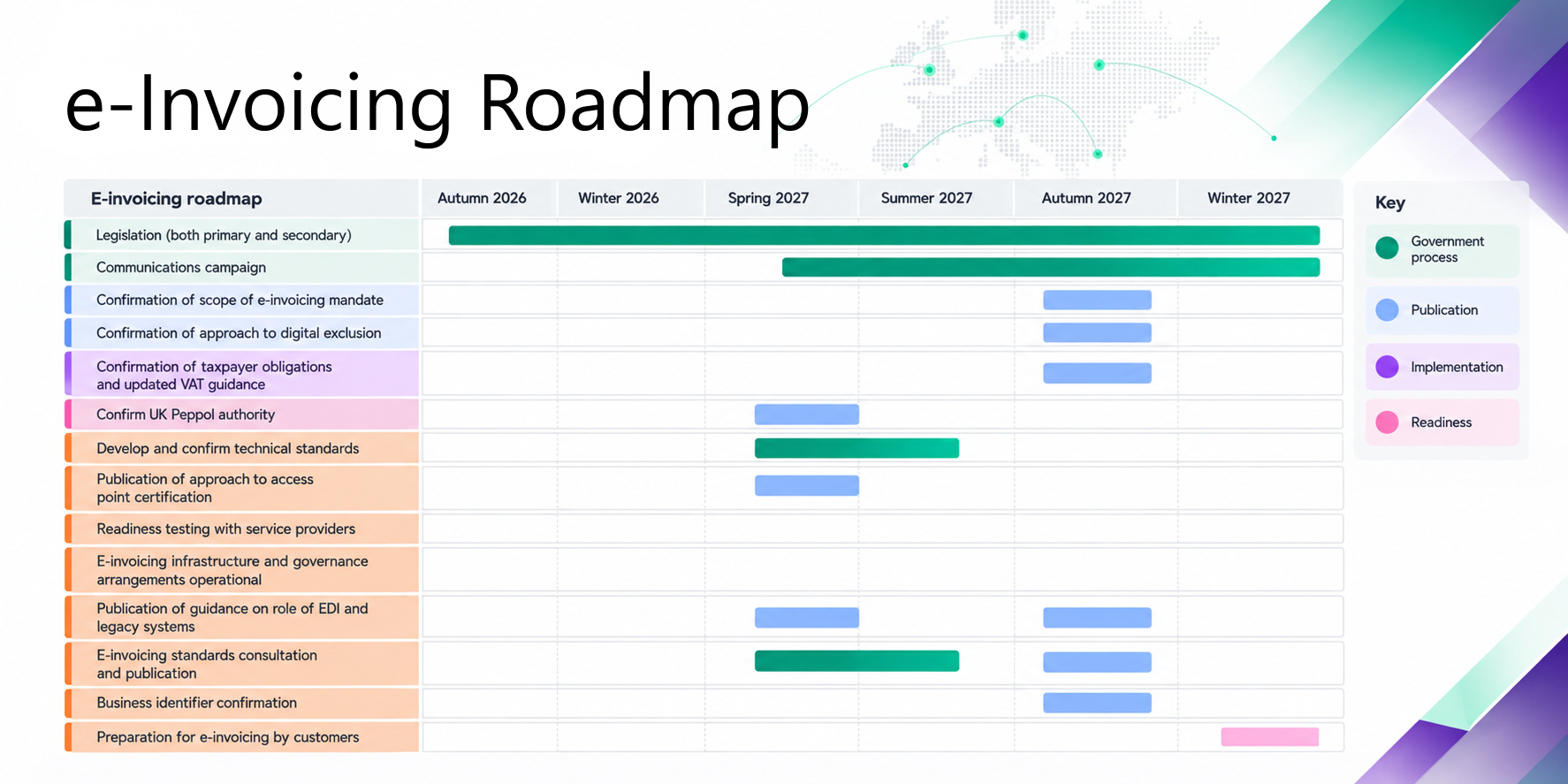
The UK decided last year that VAT invoices will have to be e-invoices from April 2029, and earlier this year it confirmed Peppol as the network that will carry them. What was missing was the order of work between those two decisions and the go-live date. On 28 October 2026, the government filled that gap by publishing its Roadmap for e-invoicing implementation.
The roadmap is not a technical specification. It is a delivery calendar that tells businesses, public bodies and software providers when each piece of the regime will be decided, published, tested and switched on. It also contains one structural announcement that changes the landscape for every service provider in the UK market: HMRC will become the UK Peppol Authority.
Key Dates
| Date | Milestone |
| 28 October 2026 | Roadmap published |
| Spring 2027 | Public technical consultation on UK standards and Access Point certification; primary legislation expected to become law |
| Autumn 2027 | Guidance on the role of EDI and legacy systems |
| October 2027 to April 2028 | Full requirements published: scope, exemptions, standards, business identifiers, taxpayer obligations and software provider rules |
| Summer 2028 | Readiness testing with software providers |
| Winter 2028 | Infrastructure and governance arrangements operational |
| 1 April 2029 | E-invoicing mandatory for VAT invoices; software providers expected to have completed UK accreditation |
[Figure 1: Key milestones]
What the Mandate Covers
From 1 April 2029, VAT-registered persons must be able to issue and receive VAT invoices as e-invoices, unless a specific exemption applies. The requirement reaches beyond companies to sole traders, partnerships, charities and VAT-registered public bodies. Non-established taxable persons (businesses registered for UK VAT without a UK presence) will follow the same rules as domestic businesses.
The scope follows existing VAT invoicing law rather than redefining it. Where a VAT invoice is required today, an e-invoice will be required from 2029. Sales to consumers and cross-border supplies fall outside the requirement, although businesses may use e-invoices voluntarily in both cases. PDFs, word-processed files, images, HTML invoices and faxes will not qualify, because an e-invoice must carry structured data that the buyer’s system can process automatically.
Exemptions are intended to be narrow, mainly for digitally excluded businesses that cannot reasonably use software or the internet, following the approach already used for Making Tax Digital.
A Fixed Twelve-Month Runway
The government has committed to giving at least twelve months’ notice of the final requirements. Everything businesses need to build against (scope, exemptions, standards, identifiers, obligations and provider rules) will be published between October 2027 and April 2028, and the government does not intend to change the requirements after April 2028 unless stakeholder feedback makes it necessary.
The legal framework follows the same logic. Primary legislation giving the government power to mandate e-invoicing is to be introduced as part of Finance Bill 2026 and is expected to become law in spring 2027. The detailed secondary legislation may not complete its passage until autumn 2028 or early 2029, so HMRC has undertaken to publish updated VAT guidance in advance of those regulations rather than hold back preparation.
HMRC Becomes the UK Peppol Authority
The UK Peppol Authority function currently sits within NHS Supply Chain, reflecting Peppol’s long use in NHS procurement. That arrangement was built for one sector. With e-invoicing extending across the whole economy, HMRC will take over responsibility for governing and overseeing Peppol in the UK. The timing and detailed governance of the transfer are still to be worked out.
The roadmap is explicit that the Peppol Authority will not receive copies of business invoices. Its role is stewardship: overseeing compliance with the international framework and any UK-specific rules, assuring software providers and coordinating with OpenPeppol.
Those UK-specific rules will take the form of Peppol Authority Specific Requirements (PASRs), the national layer every Peppol country can add. The roadmap names the areas under consideration:
- Accepted business identifiers
- Security and verification
- Reporting of network activity by providers
- Service levels
- Local interoperability
- Accreditation of software providers
What Changes for Software Providers
To join Peppol, a provider follows OpenPeppol’s certification process: self-assessment, application, review, conformance testing with an approved assessment body, a certification decision and listing in the Peppol Directory. The UK will add its own layer on top.
[Figure 2: Peppol technical certification process]
The significant point is how far that layer reaches. The UK is developing a framework of responsibilities for all software providers operating in the UK e-invoicing ecosystem, including those that do not operate an Access Point and are not subject to Peppol certification today. The publication of these requirements, readiness testing and the launch of operational infrastructure are all scheduled before go-live, and every provider is expected to have completed any required accreditation with the UK Peppol Authority by 1 April 2029.
Questions Still to Be Settled
Several design choices remain open and will be resolved within the October 2027 to April 2028 window:
- Business identifiers. The UK has no single identifier covering every type of organisation, so it must decide which identifiers can serve as a Peppol address.
- EDI and legacy systems. Businesses may keep existing EDI arrangements, but they must also be able to exchange e-invoices through the national framework. How the two will coexist in practice is still being defined.
- Penalties. The government intends to base enforcement on the existing VAT invoicing penalty framework, with details still to come.
Reporting Is Not Part of 2029
The 2029 requirement concerns the exchange of invoices between businesses only. Alongside Budget 2026, the government opened a separate consultation on whether e-invoice data could later be used for digital reporting to HMRC. The roadmap describes this as exploratory and states that no decision has been taken. Businesses should not plan for a reporting obligation in 2029, but they should expect the question to return once the invoicing network is established.
Preparing Before the Rules Are Final
The government’s own advice is that detailed implementation can wait for the final requirements. Preparation cannot. Organisations can already map how invoices are issued and received today, identify where EDI or manual processes sit, bring finance, tax, procurement and IT teams into the conversation, and assess whether their current software provider has a credible plan for Peppol and UK accreditation.
RTC, as a Peppol-certified Access Point active across more than ten Peppol jurisdictions, supports businesses in connecting to the network and will follow the UK certification and accreditation requirements as they are published.