Over the past two years, Artificial Intelligence has become the centerpiece of boardroom discussions across almost every industry. Executives are watching impressive demonstrations of generative AI capabilities – from copilots that write reports to agents that summarize data instantly.
But behind the excitement lies a much less discussed reality.
Most enterprise AI initiatives fail.
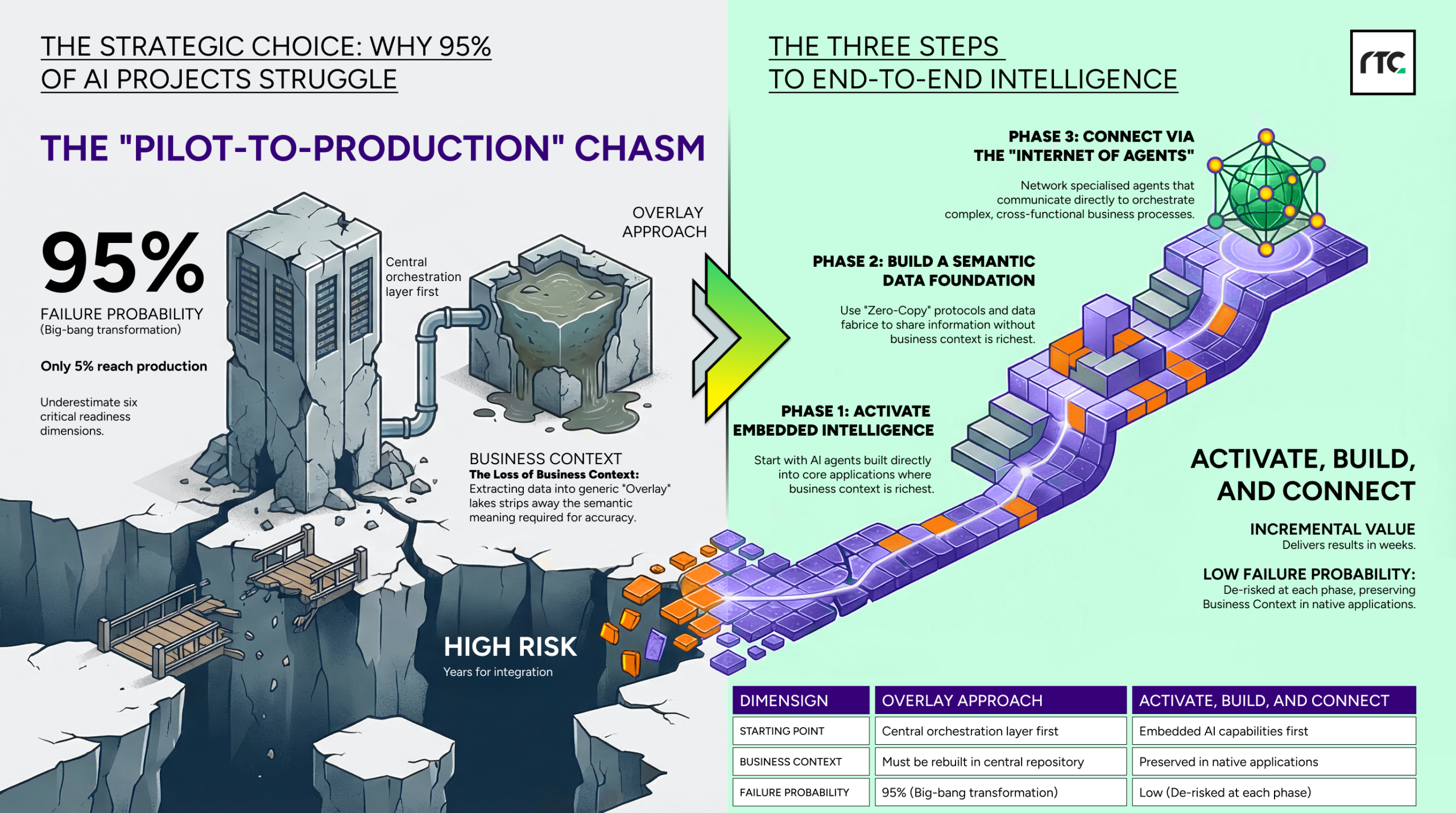
According to research from MIT Project NANDA (2025), while approximately
- 60% of organizations evaluate enterprise AI,
- only 20% reach the pilot stage, and
- a mere 5% succeed in deploying AI into production with measurable financial impact.
That means there is a 75% drop-off between pilot and production.
The problem is not the intelligence of AI models.
The problem is architecture.
For years, enterprises have been building AI systems that function like isolated brains, disconnected from the operational nervous system of the company.
To succeed in the coming agentic era of AI, organizations must stop layering intelligence on top of their systems and instead activate the intelligence that already exists within them.
The Data Lake Illusion
One of the most common mistakes in enterprise AI strategy is the third-party overlay model.
In this architecture, an external AI platform extracts data from multiple business systems and stores it in a central repository or data lake.
On paper, this sounds logical.
In reality, it often destroys the most valuable asset of enterprise data: business context.
When data is moved out of systems such as ERP platforms, it loses:
- business hierarchies
- currency relationships
- transactional dependencies
- time-dependent business logic
Rebuilding this context in another layer is extremely complex, expensive, and often impossible to maintain.
This is why forward-looking enterprises are moving toward zero-copy architectures and data fabric models.
Instead of relocating data, AI analyzes information where it already lives – preserving the semantic integrity of systems like SAP S/4HANA.
The lesson is simple:
Moving data may make AI easier to access.
But it often makes it much harder to trust.
The lesson is simple:
Moving data may make AI easier to access.
But it often makes it much harder to trust.

The answer is not better data lakes.
It is better architecture.
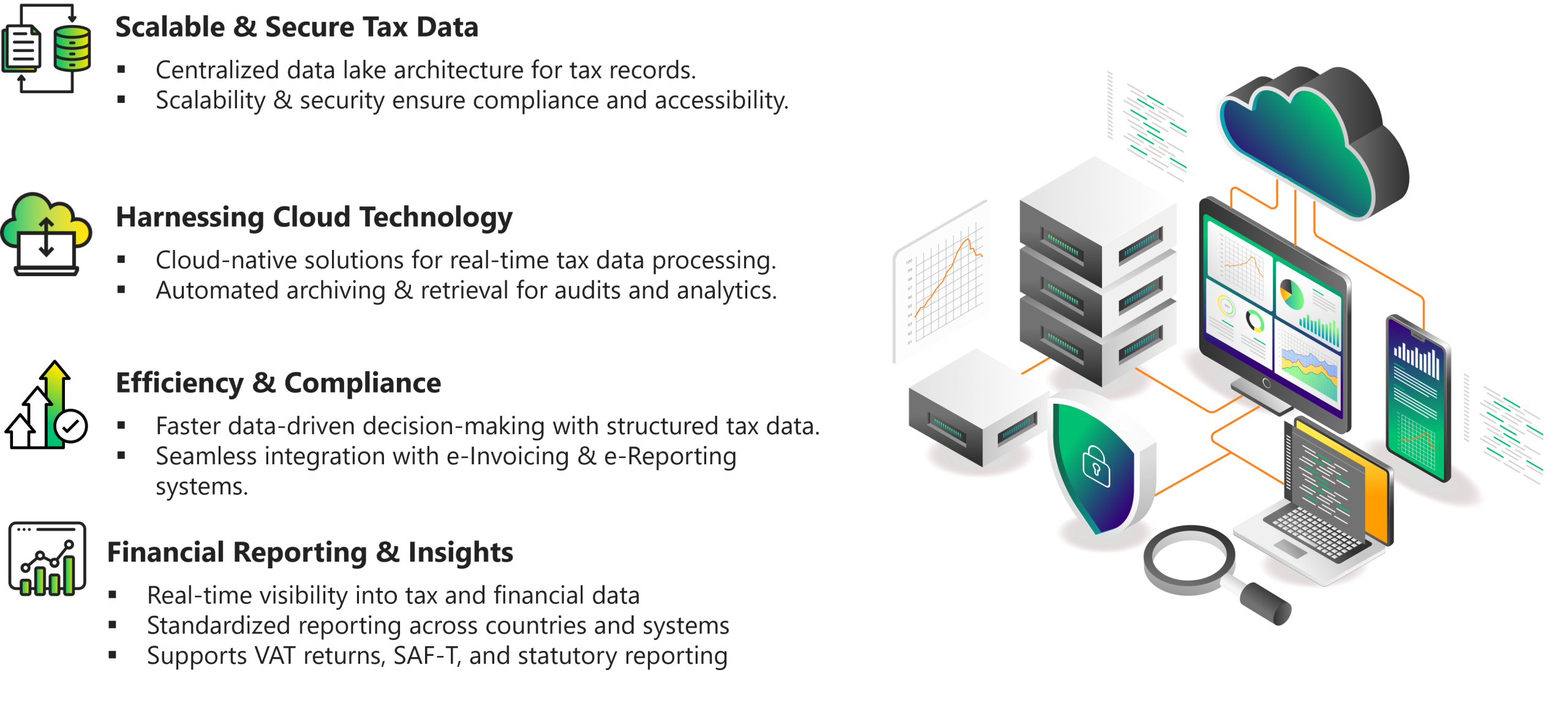
Modern enterprise systems bring together data, cloud, and AI within the same operational layer –
preserving context and enabling real-time, trusted execution.
Source: RTC – Modernizing Tax Data Management
The Pilot-to-Production Chasm
Organizations that successfully deploy AI at scale understand that the challenge is not the algorithm.
Production AI requires readiness across several dimensions.
Successful implementations typically share the following characteristics:
- Learning capability
AI systems evolve continuously through vendor updates rather than static models that quickly become obsolete.
- Workflow integration
AI operates directly inside operational workflows where decisions are made.
- Change management
Embedding AI into familiar systems dramatically increases adoption.
- Governance
Security models, compliance rules, and access controls must already exist within the environment where AI operates.
- Maintenance
Model retraining and semantic mapping should be maintained by platform providers rather than enterprise IT teams.
- Outcome orientation
The ultimate metric of success is not productivity experiments but financial outcomes – for example, reduced Days Sales Outstanding or improved working capital.
Organizations that align these elements dramatically increase their probability of crossing the pilot-to-production gap.
From “Chain of Thought” to “Chain of Action”
The first generation of enterprise AI focused on thinking.
AI systems generated insights, summaries, and recommendations.
Humans still executed the final action.
The next generation of enterprise AI is different.
It is based on Chain of Action.
Instead of simply identifying a tax anomaly, an AI agent can now initiate the corrective workflow directly within enterprise systems.
These agents can trigger:
- invoice corrections
- ledger adjustments
- compliance validations
- financial controls
To maintain trust in these automated actions, modern agent architectures rely on cryptographically verifiable identities and audit trails.
Every action performed by an agent becomes traceable, verifiable, and explainable.
For CFOs and regulators, this transparency is critical.
Automation must not reduce accountability.
It must strengthen it.
The Rise of the Internet of Agents
Enterprise AI is also undergoing an architectural transformation.
The idea of a single monolithic AI system is rapidly disappearing.
Instead, we are entering the era of the Internet of Agents.
In this model, specialized AI agents collaborate across distributed systems, each responsible for a specific domain of expertise.
Examples include agents focused on:
- VAT analysis
- cross-border transaction intelligence
- regulatory monitoring
- financial risk detection
These agents communicate through standardized protocols and operate within distributed environments optimized for performance and cost efficiency.
For enterprise leaders, this architecture enables something previously impossible:
A network of intelligent systems working together across the entire financial ecosystem.
The End of Periodic Compliance
For decades, financial compliance followed a familiar cycle.
Transactions occurred throughout the year.
Audits happened afterward.
Compliance was largely retrospective.
But digital tax systems and real-time reporting mandates are changing this model permanently.
The future is continuous compliance.
In this model, AI agents validate financial data in real time, ensuring that accounting records, tax reporting, and statutory filings remain consistent at all times.
Instead of preparing evidence for audits after the fact, organizations can generate automated audit evidence continuously.
This fundamentally changes the relationship between companies, regulators, and auditors.
Compliance shifts from a periodic exercise to an always-active capability embedded within enterprise systems.
The Strategic Choice for Leaders
Enterprise leaders now face a fundamental decision.
The traditional overlay approach to AI promises quick experimentation but often leads to years of data integration challenges and fragile architectures.
An alternative approach focuses on activating intelligence directly within existing business systems, leveraging the semantic richness and operational logic that already exists.
The difference between these two strategies determines whether AI becomes another failed experiment or a transformative capability.
The real question for leaders is no longer whether AI will transform enterprise operations.
It already is.
The real question is this:
Will your organization build AI on top of its systems, or will it activate the intelligence already inside them?
