Introduction: The Illusion of Readiness
Over the past few years, most large organizations have become aware of the global shift toward real-time tax compliance. Continuous Transaction Controls (CTC), e-invoicing mandates, SAF-T reporting, and real-time reporting (RTR) are no longer theoretical concepts, they are operational realities.
Boards are discussing it. CFOs are budgeting for it. IT teams are implementing solutions for it.
And yet, despite this awareness, a large number of organizations are not actually ready.
Not because they lack systems.
Not because they lack resources.
But because they are approaching the problem from the wrong perspective.
They are treating a structural shift as a compliance project.
That is the core mistake.
What is Real Time Tax?
Real-time tax is the continuous exchange and validation of transaction data with tax authorities as business events happen. Instead of reporting after the fact, tax determination, reporting, and compliance are embedded directly into operational processes. This means invoices and transaction data are checked, cleared, or reported instantly or near real time. As a result, compliance becomes an integrated, always-on part of how a business operates—not a separate, end-of-process activity.
The Core Misconception: “This Is a Tax Problem”
One of the most common patterns we see across enterprises is the assumption that real-time compliance is primarily a tax or regulatory challenge.
It is not.
It is fundamentally a data, architecture, and operating model problem.
Historically, tax sat at the end of the process:
- Transactions occurred
- Data was collected
- Reports were generated
- Authorities were informed
This model allowed for delays, adjustments, reconciliations, and human intervention.
That world is disappearing.
In a real-time environment:
- Transactions are validated as they happen
- Data is shared instantly with tax authorities
- Errors are rejected immediately
- Compliance becomes part of the transaction itself
Tax is no longer downstream.
It is part of the critical path of business operations.
Real Time Taxation vs Traditional Taxation
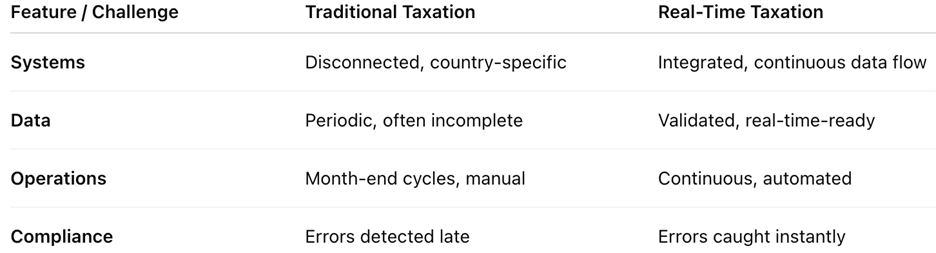
Where Most Companies Struggle
When organizations attempt to adapt, they typically face three systemic barriers:
Fragmented System Landscapes
Large enterprises operate with:
- Multiple ERP systems (SAP, Oracle, legacy platforms)
- Country-specific solutions
- Disconnected billing, payment, and reporting layers
This fragmentation makes it extremely difficult to establish a single, consistent, real-time data flow.
Instead, companies end up building:
- Local fixes
- Country-by-country integrations
- Temporary compliance workarounds
Which only increases complexity over time.
Data That Is Not “Real-Time Ready”
Most enterprise data is:
- Inconsistent
- Incomplete
- Not validated at source
In a periodic reporting world, this was manageable.
In a real-time world, it becomes a critical risk.
Because now:
- Incorrect data is rejected instantly
- Transactions fail
- Revenue can be delayed
- Customer experience is impacted
Real-time compliance exposes data quality issues that have existed for years, but were never visible.
Operating Models Built for the Past
Even more importantly, organizations are still operating with:
- Month-end closing cycles
- Manual reconciliations
- Separate tax and finance processes
But in a real-time environment:
- There is no “end of the month” for compliance
- Reconciliation must be continuous
- Tax, finance, and IT must operate as one
This is not a system upgrade.
This is an operating model transformation.
A Real-World Example: Moving Beyond Local Compliance Thinking
This challenge is not theoretical. We see it consistently in large, globally operating organizations.
Take the case of Sampa Automotive, a company with operations across 20+ countries.
Case Study: Sampa Automotive
When we started working together, the initial approach was similar to what we see in many enterprises:
- Focus on countries where e-invoicing is mandatory
- Implement local compliance solutions
- Address requirements one by one
This is the standard path.
But it quickly becomes unsustainable.
Instead, we took a different approach.
Rather than solving compliance country by country, we designed a model where:
- All transactional data across all countries
- Is generated in a machine-readable, standardized format
- And orchestrated centrally through a unified platform
This allowed Sampa to move from:
- A fragmented compliance model
To:
- A true real-time compliance architecture
Where:
- Data is consistent across jurisdictions
- Reporting is no longer reactive
- New regulations can be integrated without re-architecting systems
The key shift was simple but powerful:
From “where do we need to comply?” → to “how do we operate in a compliant way everywhere by design?”
A Hard Truth: Why Most Current Approaches Will Not Scale
There is a difficult but important reality that organizations need to face:
Point solutions will not survive this shift.
Local, country-by-country compliance strategies will fail at scale.
Because the problem is no longer local.
It is systemic.
As more countries adopt:
- Real-time reporting
- CTC frameworks
- Split payment models
The complexity does not grow linearly.
It grows exponentially.
Every new country adds:
- New formats
- New validations
- New integration points
- New operational dependencies
Trying to manage this through:
- Local vendors
- Custom integrations
- Disconnected systems
Creates an architecture that becomes:
- Fragile
- Expensive
- Operationally unmanageable
The organizations that succeed will not be the ones that implement faster.
They will be the ones that design differently.
A New Reality: Tax as Infrastructure
What leading organizations are starting to understand is this:
Tax is no longer a reporting function.
It is becoming part of the digital infrastructure of the enterprise.
This shift has several important implications:
Compliance Becomes Continuous
There is no longer a clear distinction between:
- Operational data
- Reporting data
Everything is:
- Real-time
- Validated
- Shared
The Tax Authority Becomes a System Participant
In many countries:
- The tax authority validates invoices before completion
- Or receives data instantly after issuance
- Or increasingly participates in financial flows (e.g., split payment models)
This means external systems are now part of your transaction architecture.
Failure Is No Longer Silent
In the past:
- Errors were discovered weeks later
Now:
- Errors stop transactions immediately
Compliance failures become operational failures.
The Next Phase: From Compliance to Intelligence
However, this is only the first layer.
Once you have:
- Real-time transaction data
- Standardized formats
- Continuous validation
You unlock something much more powerful:
A Single Source of Truth for Financial and Tax Data
This enables:
- Real-time dashboards for CFOs
- Continuous R2R (Record-to-Report) visibility
- Automated reconciliation
- Data quality indicators at transaction level
Instead of asking:
“What happened last month?”
Organizations can start asking:
“What is happening right now, and what will happen next?”
The Role of Data Platforms
To enable this shift, organizations need to move beyond isolated compliance solutions.
They need a data layer that:
- Connects ERP systems
- Standardizes data across countries
- Applies validation logic in real time
- Orchestrates communication with authorities
Not as a reporting tool.
But as the control layer of compliance and financial data.
The Rise of the “Internet of Agents”
Looking ahead, the transformation becomes even more profound.
We are moving from:
- Chain of Thought systems (analysis)
To:
- Chain of Action systems (execution)
In this emerging model, intelligent agents will:
- Validate transactions in real time
- Monitor data quality continuously
- Orchestrate compliance across systems
- Communicate with tax authorities
- Trigger corrective actions automatically
What This Means for CFOs
For CFOs, this is a fundamental shift.
From:
- Reviewing reports
To:
- Operating with continuous financial intelligence
Instead of asking:
- “Are we compliant?”
The system ensures:
- Compliance is continuously maintained
Instead of waiting for:
- Month-end visibility
CFOs gain:
- Real-time control over financial and tax positions
Decision Automation: The Next Evolution
This leads to:
- Continuous reconciliation
- Automated reporting
- Embedded compliance
- Real-time optimization
Human roles evolve toward:
- Oversight
- Strategy
- Exception handling
This is not just automation.
It is a new operating paradigm.
From Compliance to Tax Optimization
Today, tax optimization is:
- Advisory-driven
- Retrospective
In the future, it will become:
- Data-driven
- Continuous
- Embedded
Organizations will be able to:
- Identify opportunities in real time
- Adjust transaction flows dynamically
- Improve cash flow efficiency
- Reduce risk proactively
The Human Factor
Technology is not the only challenge.
Mindset is.
Many professionals:
- Still think in legacy models
- Underestimate automation capabilities
- Remain anchored in past systems
Transformation requires:
- Awareness
- Education
- Cross-functional alignment
What Winning Organizations Are Doing Differently
They:
- Treat this as a strategic transformation
- Invest in data quality early
- Break down silos
- Build global models, not local fixes
- Think beyond compliance
What Should You Do Now?
If your current approach is still based on:
- Local compliance solutions
- Periodic reporting
- Fragmented systems
Then the gap will continue to grow.
Leading organizations are already:
- Building centralized data layers
- Embedding compliance into operations
- Turning data into intelligence
A Final Thought
We are actively working with global organizations making this transition.
The challenge is not technology availability.
It is:
- Perspective
- Design decisions
- Willingness to rethink
Those who move early will not just comply.
They will gain:
Control. Visibility. Advantage.
And ultimately:
They will define how this new system operates.
